The Ethiopians make their gods black and snub-nosed. The Thracians make theirs have gray-eyes and red-hair. And if oxen and horses and lions had hands and could paint with their hands, and produce works of art as men do, horses would paint the forms of the gods like horses, and oxen like oxen, and make their bodies in the image of their own.
Xenophanes (circa 570-circa 478 BCE.)
 Seated mustachioed Buddha.Pakistan or Afghanistan, ancient region of Gandhara, 1st-2nd century CE.
Since the 19th century certain Buddhologists have speculated that Buddha was a member of the Scythian steppe nomads, some of whom had been encroaching since the mid-first millennium BCE into theGandhara region, becoming sedentary in the process, eventually reaching northwest India and founding an empire there in the first century BCE.
"Even a cursory acquaintance with later Vedic texts, like theUpanisads, and that of the earliest Buddhist and Jain texts leaves the reader wondering whether they can possibly refer to the same society, even though admittedly there is a time gap of a thousand years between their composition. The Sanskrit texts evoke a mostly agrarian way of life in which states play a minor part and status is governed by lineage and ritual observance. Buddhist and Jain texts, on the other hand, portray a network of functioning states, each with an urban nucleus heavily engaged in trade and production. Here wealth as much as lineage confers status. Indeed, the Buddhist concept of ‘merit’ as something to be earned, accumulated, occasionally transferred and eventually realized seems inconceivable without a close acquaintance with the moneyed economy."
This is strong circumstantial evidence for the Buddha, or the man who the story of the Buddha was based on, actually having been a Gandharan, where urbanization developed ahead of north and east India.
Another piece of circumstantial evidence is found in the Digha Nikaya [DN 1.90-95] which tells a story of Buddha's people, the Sakyas/Scythians, as being 'foreign.' They are described by Ambattha as "fierce, rough spoken, violent, wanderers (sometimes incorrectly mistranslated as menials, but refers to their mendicant lifestyle; or could it be a slight on their nomadic past?). They do not respect Brahmins, nor pay homage to them." Upon visiting Kapilavatthu, hometown of the Sakyas, Ambattha explains them as those who "sat upon high seats in meeting halls, engaging in laughing, rough playing, poking each other with fists and fingers and paid no regard to [Ambattha]." In referring to Buddha, the "Scythian-sage" (Sakyamuni), he [DN 3.144] "has blue eyes." See here and here. 
Relief panel with the Dipankara Jataka, (Megha and the Buddha Dipankara). Pakistan, Swat Valley, circa 2nd century CE.
The most visual circumstantial evidence, as the relief panel and Buddha image above show, is that Gandharan artists were still representing Buddha, (present and previous buddhas), as Aryans wearing Greek togas well into the Common Era.These are some observations to support the contention that Buddha was a Saka/Scythian:
1. Buddha was of the kshatriya (warrior) caste; foreign invaders were always co-opted into this caste by the Brahmins;
2. Buddha rejected the caste system;
3. Buddhism introduced animal motifs to India derived from the steppe peoples: the stag or deer, symbol of Buddha's first sermon in the deer park; the horse--Buddha rode out of his father's palace as a renunciate on his horse Kanthaka, which was immediately taken to heaven to be reborn among the gods; the Scythian eagle and lion griffins used as motifs at Barhut and Sanchi stupas, etc;
Relief panel with the Buddha's first sermon, showing the wheel and deer symbols.Pakistan, ancient region of Gandhara, circa 2nd century CE.
4. The cremation of bodies and the erection of burial mounds, or stupas (topes), previously unknown in India.
5. The Buddhist ideal of the chakravartin, or wheel-turning, world-conquering monarch, to which kings aspired, a concept borrowed from the steppe peoples who must have been quite familiar with wheels and wagons;
6. One of the 32 marks of the mahapurusha, or great man (Buddha was one), was that he had blue eyes. This would indicate that Buddha was an Iranian/Caucasian.
"This is not the place to examine the origin of thechakravartin ideal and its influence on the legend of the Buddha. Suffice it to say that the parallelism between the Buddha's funeral and that of a chakravartin continues a theme already implied in the doctrine of the twin careers of a mahapurusa. It is sometimes argued that this association with great kingship was intended to enhance the prestige of the Buddha as a figure of great distinction. At the same time, however, it is important to see one of the more specific implications of this.
Jean Przyluski, who has looked into Northwest Indian, Hellenistic, and, ultimately, Ancient Near Eastern traditions as sources of at least parts of the chakravartin mythology, has argued that we should look in the same direction for the origins of relic worship in India. [Watch "Alexander the God King."] He points out that Alexander the Great was divinized and that a dispute erupted over his body, which the Macedonians felt would bring happiness and prosperity to the land where it was kept. Even more specifically, he cites the case of King Menander, whose ashes (according to Plutarch) were divided among the cities of Northwest India, which erected mnemeia, [memorials, i.e., caityas], over each portion.
For Przyluski, then, the veneration of a great being's remains was intimately linked to the nascent cult of thechakravartin and both were imported ideologies. This is important because, if it is true, the fact that Buddha's body is to be treated as though it were that of a great king may not simply be intended to "glorify" or "divinize" him. More basically, it may be related to the injunction that his relicsbe preserved, and that his body not be handled like those of ordinary beings or of other sannyasins, whose remains were not preserved."
2. From The Indian Saint; or, Buddha and Buddhism: A Sketch, Historical and Critical, by Charles D. B. Mills, 1874:
[Samuel] Beal [translator of Buddhist Records of the Western Worldfrom ancient Chinese], however, advances the opinion that [Buddha] was of Scythian descent. A branch or clan of this race, he thinks, may have penetrated Northern India, as another did Assyria about this time, and Buddha was born of this blood, a descendant of Chakravarttins or Wheel Kings, i.e., universal monarchs. Sakya's directions as to the funeral obsequies to be observed after his death, the cremation of the body, and the subsequent erection of mounds, or topes, in such numbers over India,--all, he deems, indicate a foreign parentage for this saint... But this of the directions is very probably a subsequent invention; it certainly comports little with his known character, and especially with the light esteem, almost the contempt, in which he is represented to have held the body. The weight of the evidence seems altogether in favor of the view that he was of the Aryan race and family of the Sakyas. I don't agree with Mills' last part where he states that Buddha held the body in light esteem. In fact, Buddha had a very high opinion of himself and always wanted to be treated in a special way.
3. From The Indian empire: its people, history, and products By William Wilson Hunter (published 19th century).
There are indications that a branch of the Scythian hordes, who overran Asia about 625 B.C., made its way to Patala on the Indus, the site selected by Alexander in 325 B.C. as his place of arms in that delta, and long the capital of Sindh under the name of Haidarabad. One portion of these Patala Scythians seems to have moved westwards by the Persian Gulf to Assyria; another section is supposed to have found its way northeast into the Gangetic valley, and branched off into the Sakyas of Kapilavastu, among whom the Buddha was born. During the two hundred years before the Christian era, the Scythic movements come a little more clearly into sight, and in the first century after Christ those movements culminate in a great Indian sovereignty. About 126 B.C., the Tartar tribe of Su are said to have conquered the Greek dynasty of Bactria, and the Graeco-Bactrian settlements in the Punjab were overthrown by the Tue-Chi, [Yuezhi]. 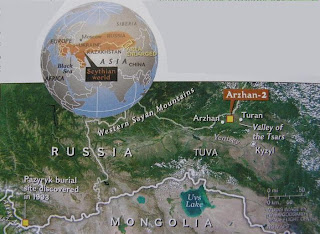
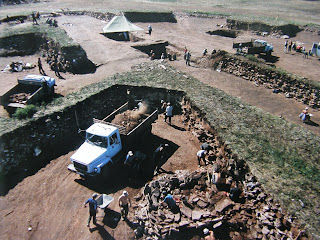 The football-field-size burial mound that Scythians made with sandstone from nearby cliffs which were the forerunner of Buddhist stupas. Above is Arzhan-2 in Tuva's Valley of the Tsars. (National Geographic, copyright infringement unintended).
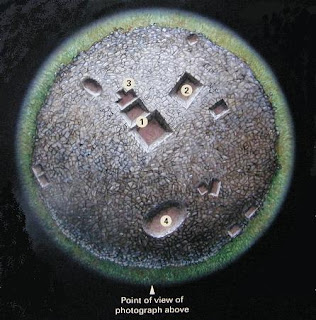 Archaeologists found undisturbed wooden vault with two skeletons and 44 pounds of gold (2). They also found rare remnants of clothing (3), a horse grave (4), but nothing at (1) where kings were usually buried.
Two centuries later, we touch solid ground in the dynasty whose chief representative, Kanishka, held the Fourth Buddhist Council, circa 40 A.D., and became the royal founder of Northern Buddhism. [Historicity of Fourth Council now doubted.] But long anterior to the alleged Tue-Chi settlements in the Punjab, tribes of Scythic origin had found their way into India, and had left traces of non-Aryan origin upon Indian civilization. The sovereignty of Kanishka in the first century A.D. was not an isolated effort, but the ripened fruit of a series of ethnical movements.
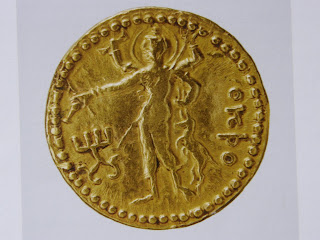 Coin of Kanishka, Pakistan, region of ancient Gandhara, circa 130 CE. Reverse, Hindu deity; Kanishka also struck coins with Buddha on the reverse, (below), where Boddo is clearly stamped.

Certain scholars believe that even before the time of the Buddha, there are relics of Scythic origin in the religion of India. It has been suggested that the Asvamedha, or Great Horse Sacrifice, in some of its developments at any rate, was based upon Scythic ideas. 'It was in effect,' writes Mr. Edward Thomas, 'a martial challenge, which consisted in letting the victim who was to crown the imperial triumph at the year's end, go free to wander at will over the face of the earth; its sponsor being bound to follow its hoofs, and to conquer or conciliate' the chiefs through whose territories it passed. Such a prototype seems to him to shadow forth the life of the Central Asian communities of the horseman class, 'among whom a captured steed had so frequently to be traced from camp to camp, and surrendered or fought for at last.' The curious connection between the Horse Sacrifice and the Man Sacrifice of the pre-Buddhistic religion of India has often been noticed. That connection has been explained from the Indian point of view, by the substitution theory of a horse for a human victim.
 Workers unearth the remains of 14 sacrificed horses; a measure of wealth on Earth and in the hereafter, horses were the mainstays in many Scythian graves. This herd is modest--Scythian graves elsewhere have been found with hundreds of horses. (National Geographic).
 Whatever significance may attach to this rite, it is certain that with the advent of Buddhism, Scythic influences made themselves felt in India. Indeed, it has been attempted to establish a Scythic origin for Buddha himself. One of his earliest appearances in the literature of the Christian Church is as Buddha the Scythian. It is argued that by no mere accident did the Fathers trace the Manichaean doctrine to Scythianus, whose disciple, Terebinthus, took the name Buddha. As already stated, the form of abjuration of the Manichaean heresy mentions [Buddha and the Scythian or Sakya], seemingly, says Weber, a separation of Buddha Sakya-muni into two. The Indian Buddhists of the Southern school would dwell lightly on, or pass over altogether, a non-Aryan origin for the founder of their faith. We have seen how the legend of Buddha in their hands assimilated itself into the old epic type of the Aryan hero. But a Scythic origin would be congenial to the Northern school of Buddhism: to the school which was consolidated by the Scythic monarch Kanishka, and which supplied a religion during more than ten centuries to Scythic tribes of Central Asia. [However, in the following article, the Sakas are said to be related to the East Iranians (i.e. they were Indo-Aryans).]
4. From Earth to Heaven--The Royal Animal-Shaped Weights of the Burmese Empire by Donald and Joan Gear:
The invasions of the Greeks, Sakas, Parthians and Kushans into the Bactria and north India regions between the 1st century BCE and 2nd century CE led to one of the most creative periods in the history of India’s art. Another important influence was that of the Romans from about the 1st century BCE to the 4th century CE.
In Ordos, bronzes with animal decoration continued until about the 5th or 6th century CE. This region is sometimes referred to as the last stand of animal art. At some time before the 2nd century BCE the Yueh-chieh [Yuezhi] in present day Kansu, not far from Ordos then at its peak of abundant production, must have contacted the Sakas of near Lake Balkash and acquired knowledge of its stag art, which, in modified form, could have been transmitted south through Szechwan to the semi-nomadic tribes of Yunnan. The Yueh-chieh subsequently drove out the Sakas (about 160 BCE) who then moved into northwest India, (Gandhara), while the Yueh-chieh became the Kushans at the west end of the Tarim basin.
The Saka retained some of their animal art but the Yueh-chieh abandoned theirs. The region from the Black Sea to Mongolia, including Central Asia, from before the 8th century BCE was occupied by nomadic steppe tribes many culturally and probably ethnically related to the East Iranians (i.e. they were Indo-Aryans). Many belonged to the Saka group. Those occupying the region north of the Black Sea were named Scythians by the 8th century BCE Greeks, those west of the Altai mountains were called Saka by the pre-6th century BCE Persians and those east of the mountains, for convenience today, are called Saka-Siberian. On the northwest borders of China and in the Tarim basin region before the 2nd century BCE were the Yueh-chieh, also probably an Indo-Aryan people related to the Sakas. They were driven along with the Sakas by the Hsiung-Nu, a Turki people. The Indo-Aryans of about 2000 BCE and the Saka group are the most important of the steppe nomads to this work.
Firstly, this is because the Indo-Aryan peoples of 2000 BCE brought to India in the Vedic religion basic concepts held by the steppe nomads which, together with Indian animism, led to Hinduism and Buddhism. Secondly, it is because tribes of, or related to the Saka group repeatedly invaded India from 2000 BCE onwards, so spreading their culture from the kingdoms and republics they established in India and thus leading to the flowering of stone architectural animal art in India from about the 2nd century BCE.
The Saka influence on animal art appears to have flowed round both sides of the Tibet plateau and converged on southeast Asia. This flow of art and people may have led to the foundation of the first Burmese kingdom, Tagaung. The Yueh-chieh were driven away from their homeland by the Hsiung-Nu about the 2nd century BCE; part of the tribe moved south towards Burma and part moved west to the northern marches of India, changing their name to Kushan as they did so. There, for about five centuries, they became a great influence on the development of Mahayanist Buddhism and overland trade from the Persian to the Chinese borders.
During their migration they drove a part of the Sakas before them and these settled in west India before temporarily extending their sway to the east of India south of the Kushans. The persistence of the word ‘Saka’ in various forms in India and Burma is noteworthy. Sakka is another name of Indra, the Indo-Aryan and Hindu god. Saka is the name of the group of tribes of which the Scythians were one. The Sakas, ‘people of the stag,’ are associated with the animal symbols of the chakravartin,(universal ‘wheel-turning’ sovereign). Gautama Buddha was the Sakyamuni, the sage of the Sakyas.  Lion capital of the pillar erected by Asoka at Sarnath. Mauryan, circa 250 BCE. Chunar sandstone, Height 2.5m. (Archaeological Museum, Sarnath).
 The lion is among the figurines created by the people of the Indus valley civilizations about 2000 BCE, though it does not become a frequently used motif, at least in durable material, until it was adopted by the Buddhists about the 3rd century BCE when it looks distinctly west Asian or perhaps Persian. The adoption of the lion motif instead of the tiger may have been because the Buddhists needed a royal symbol without the ferocious or steppe nomad association of the tiger, the emblem of the warrior caste into which Gautama Buddha was born. The stone-shafted pillars of India, usually referred to as Asokan pillars, can be separated into two age groups: pre-3rd century BCE and later. The early pillars bear, or bore, on their tops copper gilt images of the lion, the bull, and the elephant. Of these the lion image is by far the most frequent. It is also the youngest, replacing the bull and elephant images. It occurs in the region formerly occupied by the republican, warlike Licchavis and later by the Nandas. In style the images show the influence of the Anatolian Hittites (20th century-8th century BCE), as do those of the south Chinese lions of the 2nd century BCE—6th century CE. The Indian lion representation gradually changed its form, partly because most of the sculptors probably had never seen a lion, which was rare in India compared with west Asia and which today exists only in west India, and partly because it was intended to represent the broadcasting of a spiritual image. By the 11th century CE its shape had become unrealistic, humanoid, and subsequently became increasingly so. 
Left: Gold stag headdress pin; the deer became an important Buddhist icon.
Stags appear to be particularly important in the art and myths of Central Asia, the steppes and Siberia from 1500 BCE and earlier. The stag was especially used by the Altaian Saka people. It was one of the three main animals represented in their art, the others being the horse and the tiger. In the Indus valley civilizations of about 2000 BCE stag-horns were emplaced on composite creations. Portrayals show that Agni was horned. Agni was one of the chief gods of the Aryan invasion from the steppes of about 1000 BCE. Stag representations are not found again until the last two centuries BCE but then seem to be replaced mainly by ruminants with unbranched horns or does.
 The two thousand five hundred-year-old Pazyryk rug, found in 1949 on the steppes of Mongolia in a Scythian prince’s tomb, already displays all the symbols later to be associated with Buddhism: the lotus blossoms, solar symbols, stags, horses, and eagle and lion griffins.
The Scythians of east Asia adapted these motifs to their own requirements before the 7th century BCE. It is likely that the lion-griffin had reached the Altai, Siberia and China well before 1000 BCE. The Scythians preferred combat scenes with griffins as the aggressors and they themselves became especially associated with the griffin by the western world, which in fact made the association Scythia-griffin-gold because at that time, the Altai and adjacent regions produced much of the world’s gold. Lion-griffin figurines were present in Bactria in the 4th century BCE at a time when colonies of Greeks were working for the Scythians. In the 3rd-1st century lion-griffins were being made at Pazyryk in the Altai.
The Neolithic religions of the Eurasian agriculturalists appear to have been characterized by a belief in earth gods, i.e. those of the earth as a whole, of the soil and of the underworld. This belief is expressed most obviously in the forms of earth mounds, sometimes capped by stones, megaliths, dolmens, menhirs, small stone pyramids and other structures. Such occur in Central Asia, Tibet, Mongolia, Assam, Orissa, Southeast Asia, etc. Later the belief was expressed in the form of pillars in India, Yunnan and Vietnam, as stupas in much of the same region and, in Southeast Asia, as temples intended to represent mountains, e.g. many Khmer temples. The natural, or man-made, elevations seems to have been regarded as a substitute for the body of the local earth god (and later for the tribe itself symbolized through the ancestors of the rulers) within which was concentrated the power of the deity, a capping stone often serving to concentrate the power still more effectively.
Celestial gods formed part of the cosmology but were less important than the earth gods. A link between the two kinds of god was often made by the use of a pillar or tree on or near the mound, but the elevation itself, especially if high, may have served as the link. Horse sacrifices, practiced by the Mongols, Turko-Tartars, Indo-European peoples and others, were always offered to the god of the sun and sky. The horse, especially a white one, symbolized the sun. In the Altai it was the function of the shaman, in a trance, to accompany the soul of a sacrificed horse on its celestial journey and also to offer horseflesh to the ancestors. Horse sacrifices and horse burials formed part of the burial rites of these peoples throughout the entire region, the best known being those of the Indo-Aryan Scythians, Sakas and other invaders of India.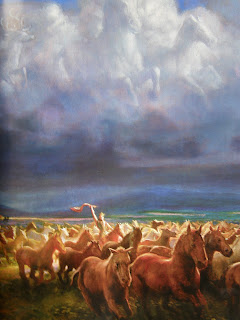 These rites and sun worship continued among the Mongols until after the 14th century CE, while Tartar chiefs continued to present thousands of white horses to the Chinese emperor until after the 18th century CE. In ancient India and elsewhere, long hair on shamans, such as the Ari favored, symbolized the snakes that appeared on the costumes and in the beliefs of the Central Asian shamans. The snake played an important role in Central Asian and Siberian mythology and on the shaman’s costume. The Indo-Aryans of about 1500 BCE, the Scythians of pre-8th century BCE and the Sakas of the same stock about 2nd century BCE all invaded India. They drank intoxicants like the Ari and took narcotics (soma, haoma) to attain ecstasy. The Sakas had ancestor cults.
In Hindu-Buddhist cosmogony there are 33 gods who reside on the summit of Mount Meru, among whom Indra (Sakka) is king. In Central Asia the people of the Altai mountains have a belief in 33 heavens. In the 7th century BCE Saka-Siberian burial site of Tuva, just east of the Altai mountains, the chief’s tomb comprises a large central mound surrounded by a stone wall 44 meters away. The annulus so-formed is separated into sections by 32 radial spokes built of stones bearing incised depictions of horses. This is a temple of the sun. The number of 32 appears also as that of the number of bodily marks of the chakravartin. There seems to be good reason to think that the 32 fiefdoms of the chakravartin are derived from the solar cult of the Indo-Aryans and reached Burma through the Sakas.
The Aryan invasion of Persia and India of about 2000 BCE introduced the Vedic religion. The descendants of the Aryans and the Saka/Scythians (sun and snake worshippers) became allies perhaps before 700 BCE, the Sakas becoming known as ‘the serpent’ or naga race, while the naga itself became one of the most important associates of the Brahmanic, Hindu and Buddhist pantheons. According to the Indian Puranas, Gautama Buddha originated from the solar race of Iskshvahu and at the commencement of his ascetic life, he was protected by the naga king. Tombs of Gautama’s own Sakya tribe, excavated in the 19th century, each contained an effigy of a naga.

Naga king and his consort--Cave Temples, Ajanta, Maharashtra.
This is one of the several pieces of evidence linking Gautama Buddha with the steppe nomads. Vedism and indigenous animism merged to form Hinduism about the middle of the 1st millennium BCE, about the same time as Buddhism emerged. In the section entitled ‘Trade’ the voyages of the allied Sakas and Indo-Aryans as traders are mentioned and it is these which may have given rise to some of the Hindu legends, such as the ‘Churning of the Oceans,’ and the association of the naga with water. Beginning not later than the 2nd century BCE and increasing during the 1st and 3rd centuries CE, Buddhism spread to Central Asia under the dominant influence of the fervently Buddhist and-commercially-conscious Kushans, (the former Yueh-chieh), whose empire stretched from north India to Bactria and from the Parthian empire of Persia on the west to that of the Chinese Han empire on the east. Eastern Persia and much of Afghanistan also adopted Buddhism, parts remaining until after the Moslem invasion.
In the shaman’s ecstatic techniques throughout central and north Asia, the number seven plays an important role, one which is due ultimately to influences from Babylon. On his costume, a Yurak shaman may have seven balls representing the seven celestial maidens. There are also the common beliefs in seven or nine each of celestial and infernal levels, though rarely, up to 33 occur. In his rites the Altaic shaman climbs a tree or a post notched with seven or nine steps to symbolize his ascent to the most powerful one. The seven steps are similar to the Buddha’s seven steps mentioned below, a concept derived from Buddhism’s parent, Brahmanism. In legend Buddha could walk immediately after his birth. He took seven steps in the direction of each of the cardinal points and claimed possession of the world. Seven days after Guatama Buddha’s birth his mother died. After Buddha’s enlightenment he meditated for three periods each of seven days. After these he was wrapped in seven coils of the serpent king, Mucalinda, and endured continuous rain for seven days. Seven also symbolizes the horse, one of the seven treasures of the chakravartin.


 bibliography of History of Indian Buddhism by Lamotte.pdf

